India’s Chip Mission Moves from Paperwork to Wafer Work
New Delhi, 2 September 2025
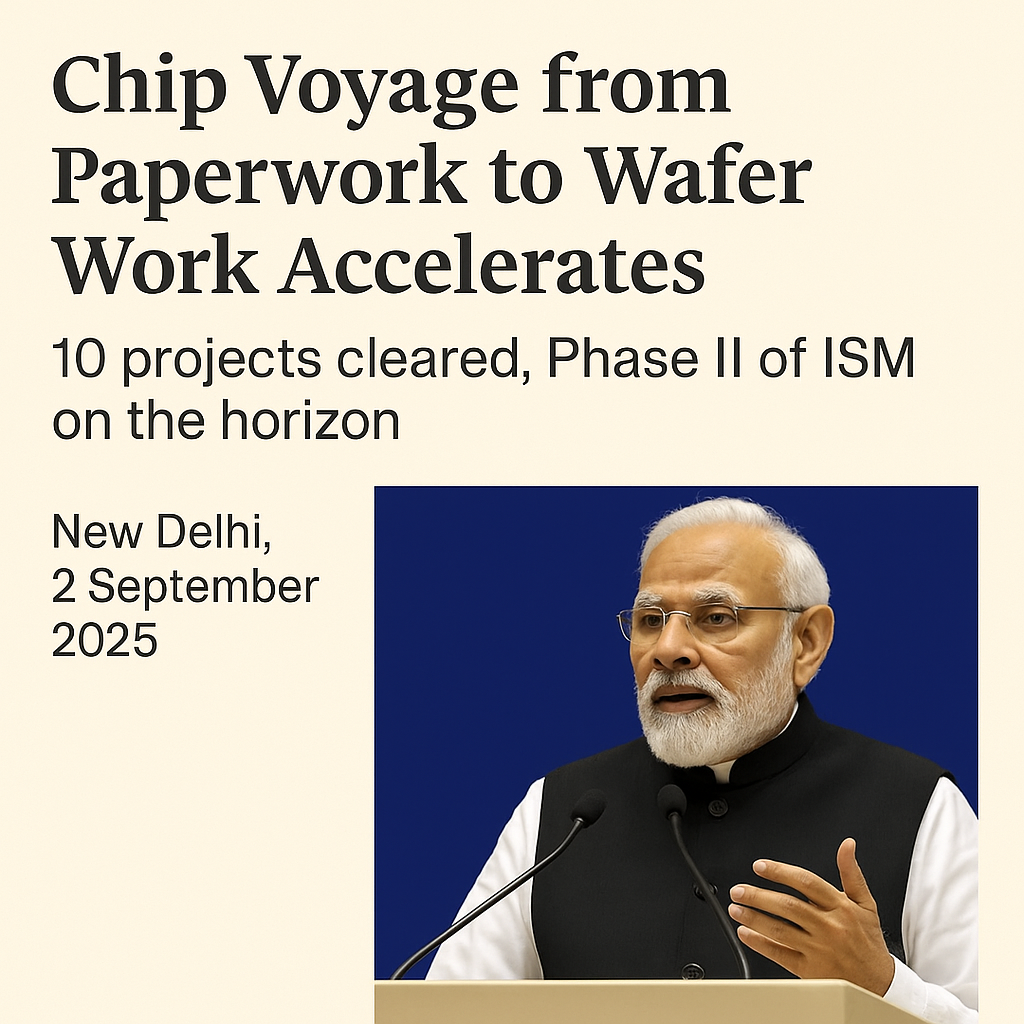
India’s semiconductor journey is picking up speed. At the fourth edition of SEMICON India, Prime Minister Narendra Modi declared that the nation is ready to become a full-stack semiconductor hub.
“Speed matters most in the semiconductor world. The shorter the time from file to factory, the faster the journey from paperwork to wafer work,” Modi said. He emphasized that India, once late to the race, is now determined to capture a major share of the global chip market, which is projected to cross $1 trillion in the coming years.
Rapid approvals and Phase II
Since the launch of the India Semiconductor Mission (ISM) in December 2021, the government has moved quickly. Within 18 months, the first semiconductor project was cleared. By 2023, approvals followed for chip fabs and packaging units. In 2024, India’s first major semiconductor fab was approved.
Today, ISM has sanctioned 10 projects:
- 1 semiconductor fab
- 1 compound semiconductor fab
- 8 OSAT/ATMP units (assembly and testing facilities)
With most of the ₹76,000 crore allocated under ISM already committed, preparations are underway for Phase II, which will expand into power electronics, automotive chips, consumer devices, medical equipment, and defence technology.
Industry in motion
Electronics and IT Minister Ashwini Vaishnaw noted that construction at five sites is advancing rapidly. A pilot line by CG Power and Industrial Solutions has already produced India’s first made-in-India chips, recently presented to the Prime Minister. Two more units are expected to start production in the coming months.
New projects worth ₹1.6 lakh crore are now in the pipeline across Gujarat, Assam, Odisha, Andhra Pradesh, Punjab, and Uttar Pradesh. Recent cabinet approvals also cleared two advanced semiconductor facilities in Odisha—one for compound semiconductors and another for 3D heterogeneous packaging.
A design push and new opportunities
The government is also revamping its Design-Linked Incentive (DLI) scheme to support 25 identified chip products across categories ranging from high-value niche chips to high-volume mass-market devices. Equipment and materials manufacturing will also receive extended support.
Industry leaders see this as a turning point. Christophe Fouquet, CEO of ASML, called India’s semiconductor growth not just an economic opportunity but also a step toward supply chain security and national resilience.
The bigger picture
With the unveiling of “Vikram,” India’s first fully indigenous 32-bit processor, and multiple projects breaking ground, the transition from policy to production is now visible. India’s ambition is clear: to move beyond assembly and become a true semiconductor powerhouse, building resilience in a world where chips define both economies and geopolitics.