
Changing Geographical Landscape of Semiconductor Industy in India
India’s electronics and semiconductor industry is entering a new phase. Earlier, most investments were focused in a few states like Karnataka, Tamil Nadu, Gujarat and Maharashtra thanks to their early industrialisation and strong government policies. However now, several other states are becoming strong destinations for companies that make chips, printed circuit boards and electronic components.
For example Odisha is emerging as one of the most promising new hubs. A company named SiCSem is building a full chain silicon carbide semiconductor plant. This type of technology is useful for electric vehicles, power electronics and clean energy. Along with this, 3D Glass Solutions is setting up a unit that will make advanced packaging and embedded glass substrates. These components are used to improve chip performance. Both plants will come up in a new cluster near the Bhubaneswar airport. This cluster has been specially planned by the state government to support electronics industries. The SiCSem investment alone is around ₹2,000 crore.
Other new locations are also appearing on the map. In Jammu, Meena Electrotech is building a multilayer printed circuit board unit. This project was selected under the central government’s Electronics Component Manufacturing Scheme (ECMS). The government hopes that this will give a strong start to industrial development in the region. However, companies still want better connectivity to the Kashmir valley and the national capital.
Goa too is seeing interest from industry. Sierra Circuits is planning a multilayer PCB manufacturing line there. PCBs are required in every electronic product — from mobile phones to defence equipment. The company expects stable demand and a supportive environment in Goa. SRF Ltd has chosen Madhya Pradesh for its new polypropylene film plant. These films are needed in electronics and other industries like automotive and textiles. The new factory near Indore will produce film that is currently imported by many Indian companies. This investment will help domestic production and reduce dependence on other countries.
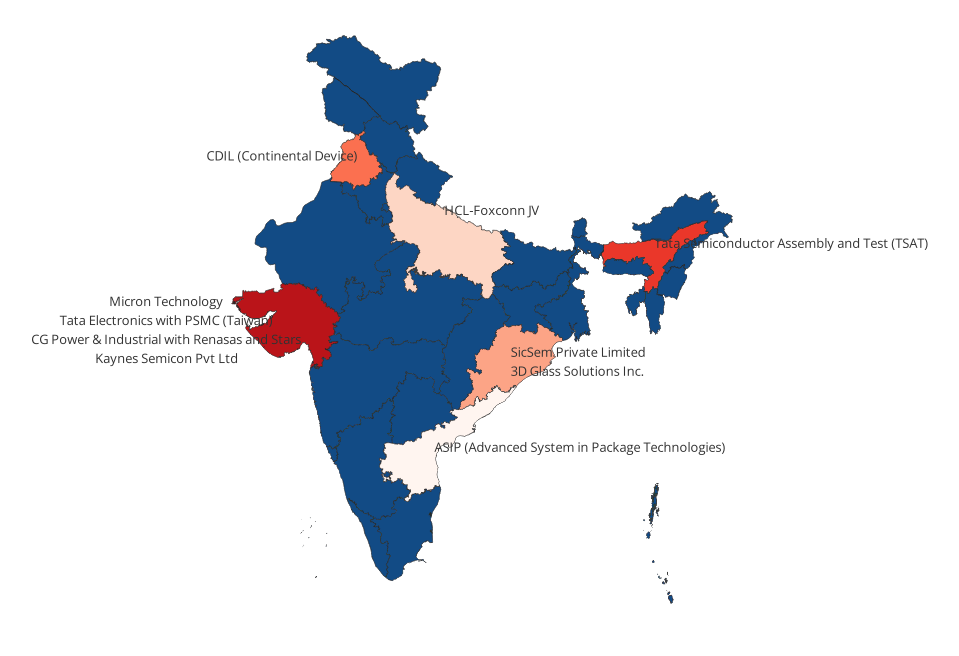
The rise of these new hubs shows that the industry believes India can overcome its power, water and logistics challenges. States like Odisha are offering low-cost land, fast approvals, and good infrastructure. This makes them attractive choices for both Indian and global companies. As on December 2025 yoga landscape has been extended over 8 state. Officials say that more investments will follow soon. The government’s schemes for component manufacturing and semiconductor production are finally showing results. Beyond big cities and traditional regions, smaller states now want a share of India’s growing industrial muscle.
This shift is important for the country. It creates jobs in new places, makes supply chains stronger and supports the wider goal of building a self-reliant electronics ecosystem. India is clearly signaling that it does not want to just assemble products. It wants to produce the critical parts that power the world’s technology.This change has only begun. More facilities are expected in the coming years, which could reshape the industrial map of India and bring new opportunities to many regions.