
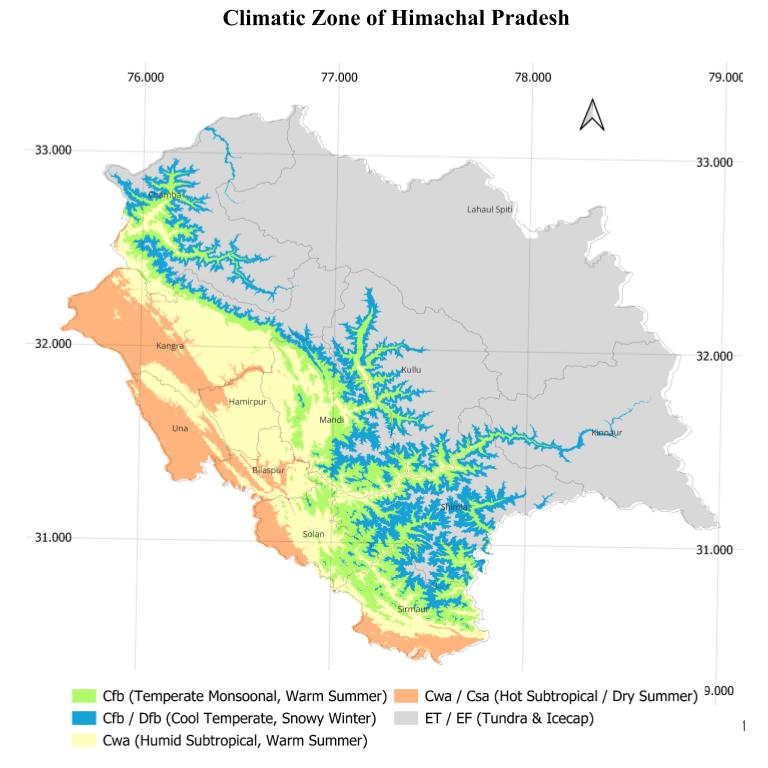
Altitudinal Climatic Zones of Himachal Pradesh – Temperature, Rainfall, and Vegetation Patterns
Map Adapted from the book “Himachal Pradesh Geography Through Maps” by Pardeep Kumar( https://www.amazon.in/Himachal-Pradesh-Geography-Through-Maps/dp/B0FJ2R4B4P)
Himachal Pradesh exhibits a clear altitudinal climatic differentiation, shaped primarily by variations in temperature and rainfall. This natural diversity influences vegetation belts, agricultural practices, and patterns of human settlement across the state.
Temperature Variation with Elevation
The temperature in Himachal Pradesh decreases with elevation:
-
- Foothill Plains (0–600 m) – Hot and subtropical climate dominates. Summers are long and warm, supporting tropical crops and dense human populations.
-
- Mid-hill Temperate Zone (1200–1800 m) – Cooler temperatures make this zone ideal for agriculture and forestry. Summers are mild, and winters can be cold but not severe.
-
- Alpine and Cold Desert Zones (above 2500 m) – These high-altitude regions experience freezing winters and short, cool summers, with a limited growing season.
Rainfall Distribution – Orographic Influence
Rainfall in Himachal Pradesh is highly influenced by the orographic effect caused by mountains.
-
- The Mid-hill Temperate Zone receives the maximum monsoon rainfall of about 1500–2500 mm annually, supporting dense forests and intensive agriculture.
-
- In contrast, the Alpine Cold Deserts of Lahaul, Spiti, and Kinnaur are the driest parts of the state, with just 200–800 mm of precipitation, most of it falling as snow.
Climatic Impact on Vegetation and Agriculture
The combined effect of falling temperatures and uneven rainfall shapes distinct vegetation belts and farming patterns:
-
- Plains and Foothills – Tropical crops, dense settlements, and year-round agriculture.
-
- Mid-hills – Temperate crops, horticulture, and mixed farming systems.
-
- High Himalaya – Sparse settlements, pastoralism, and limited agriculture due to harsh climate.
Human Settlements and Lifestyle
As altitude increases, human settlements become less dense and more adapted to extreme climatic conditions. In the plains and valleys, agriculture thrives, while in high-altitude regions, communities rely on pastoralism, seasonal migration, and limited cultivation.