IISc Scientists Create Cell-Free Enzyme System to Turn Fatty Acids into Eco-Friendly Biofuels
Bengaluru: Researchers at the Indian Institute of Science (IISc) have designed an advanced enzyme-based system that converts fatty acids into 1-alkenes – key hydrocarbons used in biofuels, plastics, and medicines.
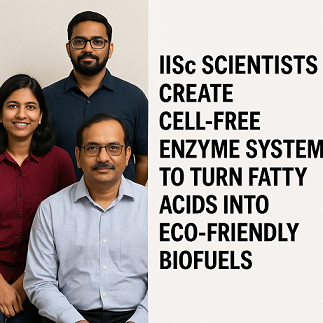
The team, led by Debasis Das, Associate Professor at the Department of Inorganic and Physical Chemistry, developed a cell-free enzyme platform that works without living cells. This breakthrough offers a cleaner, faster, and more efficient way to produce valuable hydrocarbons from renewable sources.The system uses a bacterial enzyme, UndB, which the researchers enhanced using enzyme engineering, cofactor recycling, and computer simulations. Earlier, the team had used living E. coli cells to express UndB, but the process was difficult to control and required costly cofactors.
By moving to a cell-free setup, they managed to increase the enzyme’s catalytic performance 262 times and achieved up to 98% substrate conversion. The process runs at room temperature, neutral pH, and produces no toxic waste — making it both cost-effective and environment-friendly.“Using metalloenzymes like UndB for hydrocarbon production allows us to mimic nature’s chemistry with high precision,” said Das. “Our system shows that bio-based hydrocarbon production can be both efficient and sustainable.”
The researchers also tackled a major challenge — processing long-chain fatty acids, which are more common in nature. Using molecular simulations, co-author Abhishek Sirohiwal and his team redesigned the enzyme’s internal structure to handle these larger molecules effectively.
This led to improved production of longer 1-alkenes such as 1-pentadecene, an important ingredient for pharmaceuticals and biomaterials. “We identified the key residues that decide which fatty acids the enzyme prefers,” said PhD student Subashini Murugan, a joint first author of the study.Since fatty acids are widely available in organic waste, the IISc platform could help convert waste oils into clean fuels and industrial raw materials, reducing dependence on petrochemicals. The team has also filed a patent for the technology and is seeking industrial partners for scaling up.
The study, titled Engineering of Integral Membrane Metalloenzyme UndB and Designing of a Cell-Free Biocatalytic Platform Enabled Efficient 1-Alkene Production, was published in ACS Central Science (2025).
Reference:
Iqbal T, Murugan S, Karupusamy J, Sirohiwal A, Das D (2025). ACS Central Science. [DOI: 10.1021/acscentsci.5c01099]