Turning Sunlight into Hydrogen: The Magic of Titanium Dioxide Nanotube Arrays
Imagine using sunlight to split water and produce hydrogen — a clean fuel that could power cars and homes, leaving behind only water as waste. Scientists are making it real using a tiny but powerful material titanium dioxide nanotube arrays (TNAs).
New research explores how the time spent creating these nanotubes changes their performance. In short — the longer you grow them, the better they get at turning sunlight into fuel.
What’s inside the material?
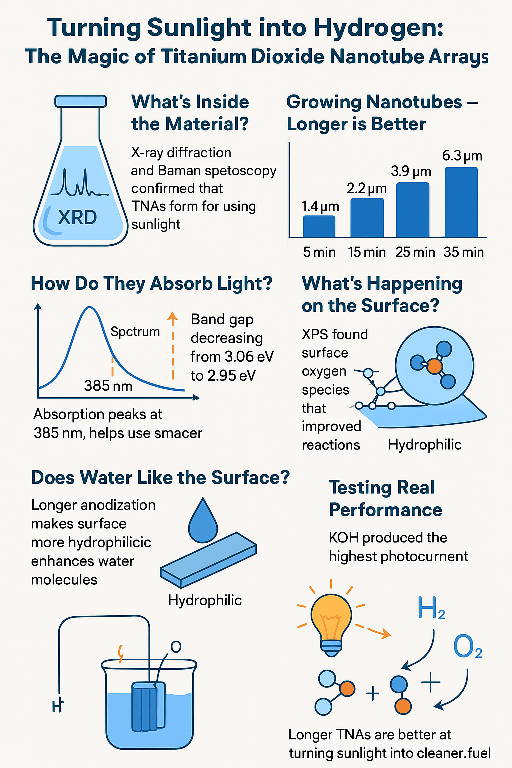
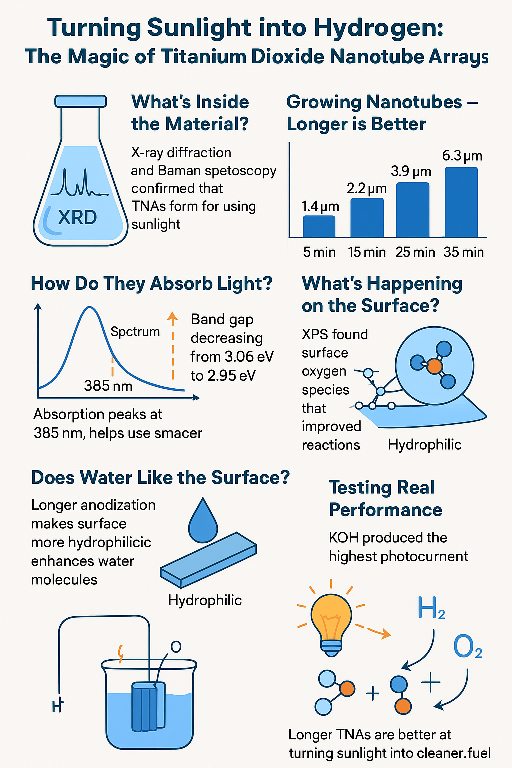
Using X-ray diffraction (XRD), the researchers found that the TNAs formed in the anatase phase — the best form of TiO₂ for capturing sunlight. No unwanted phases appeared, meaning the structure was pure and stable. Raman spectroscopy confirmed the same — all peaks matched anatase TiO₂ perfectly.
Why does this matter?
Because a purer crystal absorbs more sunlight and creates more electric charges, which later split water molecules into hydrogen and oxygen.
Growing nanotubes — longer is better
The team used a process called anodization to make TiO₂ nanotubes. When they increased the anodization time, the tubes got longer:
- 5 minutes → 1.4 µm
- 15 minutes → 2.2 µm
- 25 minutes → 3.9 µm
- 35 minutes → 6.3 µm
Longer tubes mean more surface area — more space for sunlight to hit and reactions to happen. It’s like adding more solar panels in the same area.
How do they absorb light?
When light hits the TNAs, they absorb energy at around 385 nm (in the UV range).With longer anodization time, the band gap (energy needed to start the reaction) slightly decreased — from 3.06 eV to 2.95 eV.This small change helps TiO₂ use sunlight more efficiently. And here’s a main part — when scientists checked how much light the material re-emitted (called photoluminescence), it glowed less for longer anodized samples. That means fewer wasted electrons — more power for splitting water.
Using X-ray photoelectron spectroscopy (XPS), they found titanium and oxygen in their expected oxidation states — no harmful impurities. Some oxygen atoms sat loosely on the surface, which actually helped improve reactions by attracting water molecules.
By measuring the contact angle (how a water droplet sits on the surface), the team saw a change from slightly water-repelling (hydrophobic) to slightly water-loving (hydrophilic) as anodization time increased.
That helps water spread evenly, making reactions smoother and faster.
Final Say
When the researchers tested the TNAs in different electrolytes, KOH (potassium hydroxide) performed best. It helped the nanotubes move charge faster and split water more efficiently.
Under sunlight:
- Shorter nanotubes gave small currents.
- Longer nanotubes (35-TNA) produced the highest photocurrent — meaning more hydrogen!
Their efficiency (Solar-to-Hydrogen ratio) increased steadily from 0.34% to 0.45% with longer anodization.
The impedance (resistance to charge flow) also dropped — proving that longer nanotubes made the pathway for electrons smoother.
Research Conducted by : Research conducted by:
SWARNA LAKSHMI RAJENDRAN and VISWANATHAN ALAGAN
Department of Physics, Government College of Engineering, Sengipatti, Thanjavur, Tamil Nadu, India
and Department of Physics, University College of Engineering – BIT Campus, Anna University, Tiruchirappalli, Tamil Nadu, India