
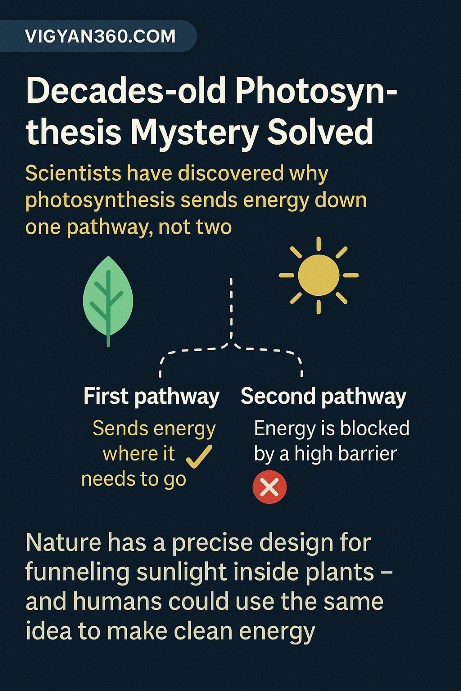
Mystery of Photosynthesis Finally Solved
IISc and Caltech scientists discover how nature makes sunlight flow perfectly
Date: October 13, 2025
Source: Indian Institute of Science (IISc), Bengaluru & California Institute of Technology (Caltech)**
Journal: Proceedings of the National Academy of Sciences (PNAS)
How it all began
Photosynthesis is one of nature’s greatest inventions — the process that plants use to turn sunlight, water, and air into food and oxygen.
But scientists had been puzzled for decades by a strange mystery: why does energy inside plants travel only through one of two possible pathways?
Now, a joint team from IISc, India and Caltech, USA has finally found the answer.
The secret inside plants
Inside every green leaf is a complex structure called Photosystem II (PSII).It’s like the power plant of photosynthesis. PSII catches sunlight and splits water molecules, producing oxygen and releasing electrons that carry energy forward.
PSII has two similar routes for these electrons, called D1 and D2. Both look almost identical — but strangely, only D1 works.
For years, scientists couldn’t understand why D2 stayed silent.
What the researchers found
Using powerful computer simulations and quantum calculations, the IISc–Caltech team discovered that:
- The D2 branch has a much higher energy barrier, meaning electrons find it too hard to move through.
- The D1 branch, in contrast, has smoother energy flow and better alignment of pigments (chlorophyll and pheophytin).
- The resistance to current in D2 is about 100 times higher than in D1.
In short — nature built a two-lane road for electrons but blocked one lane to make sure all energy flows in a single, efficient direction.
Why it’s important
This “one-way” design makes photosynthesis extremely efficient.By sending energy through only one channel, plants avoid energy loss and keep the process steady and reliable.
“This is nature’s engineering at its best,” says Prof. Prabal Maiti of IISc.“It shows how every step in photosynthesis is finely tuned for maximum performance.”
How it can help humans
Understanding this hidden rule of photosynthesis could help scientists design artificial systems that mimic plants — for example:
- Artificial leaves that turn sunlight into fuel.
- Solar panels that copy how plants control energy flow.
- Clean energy technologies that use natural principles to store and convert sunlight efficiently.
The team’s models even suggest that by changing a few pigments in the D2 branch, both lanes could be activated — potentially doubling energy efficiency in artificial systems.
A global collaboration
“This work brings physics, chemistry, and biology together,” says Prof. William Goddard from Caltech.“It helps us understand how life on Earth captures energy — and how we might use that knowledge to build a cleaner future.”
Why it matters for everyone
Every breath of oxygen, every green leaf, every piece of food — all exist because of photosynthesis.
By uncovering how it really begins, scientists have taken a big step toward creating new ways to power our world the same way nature does — with sunlight.
Key takeaway:
Nature sends sunlight down one perfect path for a reason.Now that we finally understand how, we may be closer to turning light into life — and clean energy — just like plants do.