Renewable Energy, Electric Vehicles, and the Electric Eel Algorithm
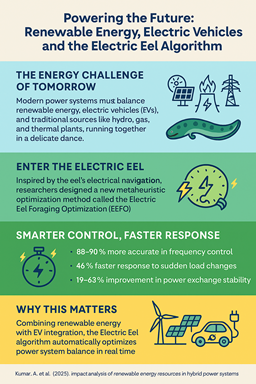
The Energy Challenge of Tomorrow
Modern power systems are no longer simple. Today’s grids must balance renewable energy, electric vehicles (EVs), and traditional sources like hydro, gas, and thermal plants — all running together in a delicate dance.
But there’s a catch the renewable energy is unpredictable, and EVs are both a load and a storage unit. This makes Load Frequency Control (LFC) — the system that keeps the grid’s heartbeat steady — far more complex than before.
Fluctuations in solar or wind power, or millions of EVs charging simultaneously, can make frequency swing up and down in milliseconds. Keeping stability now demands not just good control engineering, but intelligent adaptation.
Electric Eel Optimization in Hybrid Power Systems
Smarter Control for Renewable Energy and Electric Vehicles
The Challenge
Hybrid power systems combining thermal, hydro, gas, renewables, and electric vehicles are difficult to stabilize. Renewable sources fluctuate, and EVs act as both load and power suppliers — making Load Frequency Control (LFC) complex.
The Innovation
Electric Eel Optimization (EEFO)
Inspired by electric eel behavior, EEFO efficiently explores and optimizes control parameters for stability.
FOI-PDF Controller
Fractional Order Integral–Proportional Derivative with Filter (FOI-PDF) controller ensures faster frequency recovery and smooth operation.
Hybrid Power Network
Two-area interconnected system integrating thermal, hydro, gas, solar, wind, and electric vehicles for balanced performance.
Key Results
88–90%
Reduction in frequency error (ITAE)
46%
Faster frequency stabilization
63%
Improved tie-line stability
Why It Matters
EEFO enables real-time adaptive control for renewable-heavy grids. By learning from nature, it creates more resilient, stable, and intelligent power networks — a key step for the future of sustainable energy startups.
Enter the Electric Eel
In a fascinating twist, researchers Anil Kumar, Saurabh Chanana, and Amit Kumar took inspiration from an unlikely source — the electric eel. These creatures use electrical pulses to navigate murky waters and hunt prey efficiently.
Inspired by this biological strategy, the team designed a new metaheuristic algorithm called the Electric Eel Foraging Optimization (EEFO). This optimization method learns, adapts, and searches for the best control parameters in a constantly changing power environment — just like an eel navigating uncertain waters.
The Innovation: FOI-PDF Controller + EEFO
The research introduces a Fractional Order Integral–Proportional Derivative with Filter (FOI-PDF) controller — a refined version of the classic PID controller — paired with the new EEFO optimizer.
This combination powers a two-area hybrid power system that integrates:
- Thermal, hydro, and gas plants
- Renewable energy sources (solar and wind)
- Electric vehicles (EVs), which can act as both consumers and energy contributors
The system is tested for real-world disturbances, like sudden load changes and communication delays (common in smart grids).
Smarter Control, Faster Response
The Electric Eel algorithm outperforms every existing optimization technique it was compared against — including the popular Whale Optimization Algorithm, Ant Lion Optimizer, and Sine Cosine Algorithm.
Here’s what the numbers say:
- 88–90% better accuracy in frequency control compared to older methods
- 46% faster response in stabilizing frequency under sudden load changes
- 19–63% improvement in power exchange stability between connected regions
All of this was validated on the OPAL-RT real-time simulation platform, confirming not just simulation success, but physical feasibility.
Why This Matters
The EEFO + FOI-PDF combination could redefine how smart grids handle the chaos of renewable energy and electric vehicles. By automatically tuning itself in real time, it keeps power frequency stable under uncertainty, supports faster renewable integration, reduces the need for manual recalibration, and improves the resilience of interconnected systems.
This kind of algorithmic intelligence is exactly what the next generation of AI-powered energy startups will need — systems that learn, adapt, and optimize continuously.
The Big Picture
The energy landscape is evolving from rigid control to adaptive intelligence. Renewable energy doesn’t have to mean instability; it just requires smarter algorithms to balance it.
By taking inspiration from the electric eel — nature’s own energy manager — this research brings us one step closer to self-regulating, AI-driven power systems that can manage the complexities of a clean-energy future.
Citation:
Kumar, A., Chanana, S., & Kumar, A. (2025). Impact analysis of renewable energy resources and electric vehicles in hybrid power systems. Computers & Electrical Engineering. https://doi.org/10.1016/j.compeleceng.2025.110729