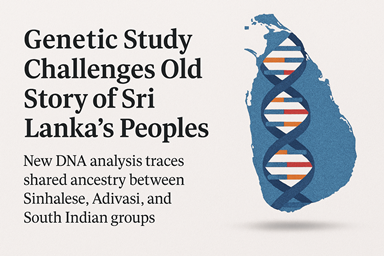
Genetic Study Challenges Old Story of Sri Lanka’s Peoples
Genetic and history in India is controversial topic , sepcially given the its politcal consequence. We have seen these controversy since India get Independence. Right wing Hindu always try to fix their root in Indian subcontinent. Similar is the case with Sirlankan politics. However, a new genome study is reshaping how scholars think about Sri Lanka’s population history. By sequencing the DNA of 54 individuals 35 Sinhalese and 19 Adivasi belonging to two clans an international team from India, Sri Lanka, and the United States has traced deep genetic connections between Sri Lanka and southern India.
The results show that both Sinhalese, the island’s largest ethnic group, and the Adivasi, who still speak the unique Vedda language, share significant ancestry with Dravidian-speaking groups such as the Irula, Paniya, Mala, and Madiga in Tamil Nadu and Andhra Pradesh. This finding complicates the long-held historical account that the Sinhalese migrated from northern India around 500 BCE, a version supported by the Indo-European roots of the Sinhala language and early chronicles.
Geneticist Niraj Rai notes that the Sinhalese and Adivasi cluster far more closely with populations carrying high levels of so-called Ancestral South Indian ancestry than with groups in central or northern India. That observation contrasts with earlier work, including studies that pointed to a western Indian origin by highlighting affinities with the Maratha population.
Maanasa Raghavan, an ancient DNA expert at the University of Chicago, urges caution in interpreting the discordance. Written records and language change track cultural shifts, while genetic ancestry reflects biological mixing. People migrate, identities change, and regions occupied today may not align with those of two millennia ago. She argues that only DNA retrieved directly from archaeological remains can settle the question.
The study also confirms that the Adivasi, still living in small hunter-gatherer communities, carry genetic signatures linking them to tribal groups in southern India. Archaeological and linguistic research has long placed the Vedda as the island’s earliest inhabitants, followed later by Tamil and Sinhalese arrivals. The genetic record now supports the idea of early admixture between Adivasi and migrants from the mainland, while showing little evidence of gene flow from outside South Asia.
Not all experts agree on the implications. Gyaneshwer Chaubey of Banaras Hindu University, a co-author of earlier mitochondrial DNA studies, says the new results do not fully capture the depth of Vedda–mainland links and calls for analysis of paternal lineages. Geneticist Partha Majumder adds another layer, suggesting that northern Indian founders could have mixed extensively with southern Indians over generations, shifting the Sinhalese genetic profile while preserving their Indo-European language.
The study’s limitations are clear: only two Adivasi clans and a modest Sinhalese sample were included. Assimilation of Vedda individuals into Sinhalese communities in recent centuries also blurs boundaries, making it difficult to isolate ancestral signals. Researchers stress the need for larger datasets spanning more regions of Sri Lanka.
Despite these caveats, the work highlights the importance of integrating DNA research with archaeology, linguistics, and anthropology. It also underscores the value of community engagement — the scientists plan to return to Sri Lanka to share findings directly with the groups who participated. Similar large-scale genome projects among Dravidian-speaking and tribal groups in India could help reconstruct a fuller picture of South Asia’s past, one that acknowledges the centuries of movement, mixing, and cultural transformation across the region.