Indians Least Aware of Artificial Intelligence, Yet Show Highest Trust in Government Regulation: Global Survey
A new survey conducted by the Pew Research Center across 25 countries has revealed a striking contrast in India’s relationship with Artificial Intelligence (AI). While Indians are among the least aware of AI globally, they also show the highest level of confidence in their government’s ability to regulate the technology effectively.
Low Awareness Levels
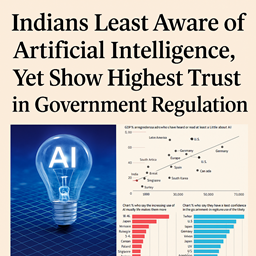
According to the survey, only 14% of Indians said they have heard or read a lot about AI, while another 32% said they have read or heard a little. Together, this totals just 46%, which is the lowest awareness level among all 25 countries surveyed. In comparison, the median awareness across countries stood at 81%.The data show a strong connection between awareness and national income. Countries with higher GDP per capita, such as the U.S., Germany, and the U.K., have much higher awareness levels—above 70%. Meanwhile, developing nations like India, Kenya, and Turkey remain on the lower end of the awareness scale.
Young Adults Also Lag Behind
The survey also highlights low awareness even among India’s younger population, aged 18–34, who are generally expected to be more informed about technology. Only 19% of Indian youth in this age group said they have heard or read about AI—a figure that is the second lowest among all participating countries. By contrast, in Germany and the U.S., more than 70% of young respondents were aware of AI.
Mixed Emotions About AI in Daily Life
When asked how they feel about the increasing use of AI in daily life, only 19% of Indians said it makes them more excited than concerned. This is one of the lowest shares among the surveyed nations. The majority of Indians expressed caution, worry, or uncertainty about AI’s growing presence.
In comparison, countries like the U.S. (50%) and Germany (43%) reported much higher excitement about AI integration in daily life. These differences point to varying levels of exposure and familiarity with AI technologies across countries.
High Trust in Government Regulation
Paradoxically, despite having the lowest awareness, Indians expressed the highest faith in their government’s ability to regulate AI effectively. Nearly 89% of Indian respondents said they trust their government to manage AI responsibly. The next highest levels of trust were seen in Indonesia (74%) and Germany (71%).This strong trust contrasts with the skepticism seen in several developed nations, where citizens tend to be more aware of AI but less confident in government oversight. For instance, in the U.S. and the U.K., fewer than half of the respondents said they trusted their governments to regulate AI effectively.
Global Patterns and Implications
The results show that AI awareness is closely tied to a nation’s economic development, education level, and digital exposure. Countries with high internet penetration and strong research ecosystems have populations that are more informed about AI and more actively engaged in discussions around its benefits and risks.
In India, the low awareness could reflect limited access to AI-related education, a still-growing digital literacy rate, and a technology narrative dominated by mobile apps rather than advanced AI concepts. However, the strong confidence in government regulation suggests that Indians view technological governance as a matter best handled by public institutions rather than private companies.
Conclusion
The survey paints a complex picture of India’s AI landscape: a nation that is optimistic about its government’s ability to manage technology but still lacks widespread understanding of what AI truly is and how it affects daily life.As AI continues to shape global economies, the challenge for India will be to bridge this awareness gap—ensuring that its large and youthful population not only trusts in AI regulation but also participates in shaping how the technology evolves in the country.